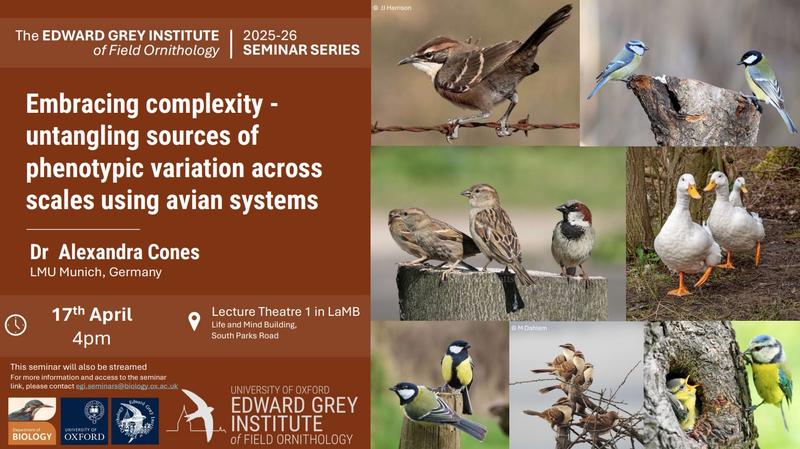
All organisms respond to their environment, but these plastic phenotypes vary across scales - within species, populations, and even individuals. We expect selection to deplete this variation in favour of an optimal plastic phenotype, raising the question - why does this variation persist across scales? One possibility is that this variation is not adaptive. An alternative, intriguing possibility is that this variation is indeed adaptive: any single plastic response may trade-off with the expression of other traits, and the optimal resolution of this trade-off may vary in fluctuating environments. Untangling this complexity requires consideration of the multidimensional nature of plastic phenotypes. I will discuss how I've been chipping away at this complexity by applying multilevel, hierarchical analysis to plastic phenotypes in a variety of avian model systems. My work demonstrates that responses to both the social and abiotic environment vary at multiple scales, that this variance can arise from different mechanisms, and its adaptive value is dependent on its covariance with other traits and fluctuations in the environment. Embracing this complexity, with the help of cutting-edge modelling approaches, is key to understanding the evolution of variation in phenotypes more broadly.
Dr Alexandra Cones
LMU Munich, Germany
List of site pages